Showing posts with label caterpillars. Show all posts

Thursday, September 12, 2013

Glad somebody thinks it's fall...

Goodness knows, summer seems to have returned after the teasers of mid-50° nights we had the other week. But just as retail stores are decked out in Halloween and other autumnal decorations, this little caterpillar is showing off its fall colors.

A coworker gets a bit miffed at people making up new names for beasties that already have names that have been used without trouble for a very long time (that's a Brit for you). But I have to admit that I like "Halloween Paint" much better than "Camphorweed Cucullia" for this glorious little creature... (And before you ask, it turns into a dull little brownish grayish moth, whose only distinguishing feature is a furry "hood" over its head. Here we call them "Hooded Owlets" but the British name for the moth group is, admittedly, more fun: Sharks.)


Thursday, May 23, 2013

Two Tent Caterpillars


How wonderful! By sheer luck I found two species of tent caterpillars in my yard...


A caterpillar quite common to most of us, Eastern Tent Caterpillars are quite fond of cherry trees--anyone raised in even a suburban area should be familiar with the thick white webs in cherry trees--but they will utilize many other members of the Rose family as well. (Yes, apples, pears, plums, peaches and cherries are actually in the same plant group as roses.) Large, older caterpillars have spread in my yard from the black cherry tree where I found the egg case and web to the multi-flora rose bushes (food plant in the photo below).


While puttering around my front deck, I found the beastie below on the wall of my house. This blue beauty is a Forest Tent Caterpillar. I assume it earned the name "Tent" because of its similarity to the Eastern Tent (they have been put in the same genus, Malacosoma)… Thing is though, Forest Tent Caterpillars don't build tents. But the "Forest" is apt; this species prefers oaks and maples--trees that form what we call forests.


My caterpillar book likens the white spots to "footprints" but is it just me or do they look exactly like dancing Snoopy's…? (Or penguins the other way round, as was suggested by a fellow caterpillar lover.)


Comparison shot. Forest Tents average smaller than Eastern Tents, but there might be two instars (age/development levels) represented here as well. That's about as big an Eastern Tent as I've ever seen. And still it spent the afternoon eating--yikes.

Please don't expect a follow up to the metamorphosis of these… While the caterpillars are absolutely stunning, they form drab cocoons rather than chrysalises, and the moths they turn into are about as bland as a plain brown moth can get.

Saturday, May 18, 2013

What's in a name?

Names can be a nuisance. They either get it right or get it wrong. And sometimes they correct a misnomer...


Eastern Tent Caterpillar:


This is the variety found in the eastern US (yes, there's a western species) and they are not only social caterpillars, they build a three-dimensional triangular web--aka, tent--in the fork of a branch of their food plant and retreat into it for safety (and possibly for temperature regulation).


Forest Tent Caterpillar:


Okay, looks a bit like an Eastern Tent, but this one is predominately blue. Taxonomically, these two are cousins, both assigned the genus Malacosoma. Forest tent caterpillars, like Eastern, are also social, in that they hang out together with their siblings on their preferred tree when they aren't eating. (Many moth caterpillars are gregarious; butterfly caterpillars tend to be loners.) Forest Tent caterpillars do not, however, form tents…


Juniper Hairstreak:


This stunning little (it's maybe an inch long if it stretches its wings) butterfly's caterpillars feed on red cedar trees. Which aren't really cedars… They're, well, junipers.

A rose is a rose is a rose and by any other name… Gosh, I sure hope so.

Saturday, September 15, 2012

Ooh, an inchworm! And it's...orange.


Even though it wasn't doing much (beyond groping for the stem above where it sat on the edge of a leaf, but not actually going anywhere once it grabbed hold), this little thing certainly caught my eye as I was enjoying the view of my backyard from just inside my greatroom's glass door.


Been spending a lot of time there instead of on the decks. Far fewer mosquitoes inside than out. Luckily, I have a pretty nifty back yard and a great view from inside the window. But an orange inchworm was definitely worth the risk of going outside...


It's a caterpillar of a moth commonly called a "pug". Drab little things, the moths; their inchworms are much more interesting, especially this gold and chevron-ed beauty.


The book states that these larvae often match the color of their host (food) plant. But it is not known how they do it. Indeed, not a flower petal was nibbled, which you'd think would be the most obvious way to pick up that eye-aching orange of a Mexican sunflower....


Nice to know there is still magic in the world, and so well represented by one wee orange inchworm...


Friday, July 6, 2012

Insect Collection I.

Is creating an insect collection still standard protocol for elementary school science classes, or is it no longer politically or environmentally correct?

I tried for the most variety as much as the next kid working on that assignment, but I must admit that photography is a much cooler way of doing it. And your specimens actually look alive! (I'm sorry, I have never been able to appreciate Audubon's work. They all look like paintings of dead birds to me. I suppose you could say they were "true to life"; after all, they were paintings of dead birds… "Shoot first, study later" was the motto of the day. Hmm. Guess it still was even into my generation.)

Sure would be nice to think that they send kids out with a camera these days instead of a collection jar with a nail polish remover-soaked cotton ball in it…


Silver Spotted Skipper on Pickerel-weed.


Black Swallowtail on Buddleia.


Nymph with shed skin. They're really cute this small! It's those eyes.


Ladybeetle on star flower (Amsonia).


Painted Lady and Black Swallowtail.


Little Wood Satyr on Tulip Tree.


Eastern Comma.

Tuesday, September 13, 2011

Before, Between (and some After).


 Buckeye before.


 Buckeye after.


Black Swallowtail before.


Black Swallowtail getting ready.


Black Swallowtail in between. (Simply had to show a close-up of the shed skin.) [Argh. Somebody or something disappeared the chrysalis. Rats. Was hoping for a good emergence series. Phooey.]

See the new blog header for the adult black swallowtail. ;o)


Monarch caterpillar.


Monarch getting ready--spinning a silk anchor pad (the bit to the right).


Monarch getting ready.


A monarch getting ready, and one waiting.

(To be continued...)

Tuesday, September 6, 2011

Monarch Caterpillar Courts Disaster. (video)

Bet you think this won't end well...


Hah! Wasn't what I expected, either. The only slight of hand in this video is that you can't see the glass aquarium that held up the leaf tip--temporarily, anyway; it did fall a minute or two later, taking the caterpillar with it. Poor wee beastie appeared a bit shaken after it had booked across the bottom of the tank, so I returned it to another milkweed leaf.

Be sure to check out Cape May Bird Observatory's Monarch Monitoring Project! (See also the project's official website and their monarch blog.) They are maintaining monarch caterpillar tanks again this year at CMBO's Northwood Center to allow for easy, up-close viewing of caterpillars, chrysalises and emerging butterflies. Team members will also be giving monarch butterfly tagging demos at Cape May Point State Park starting in mid-September.

Wednesday, June 15, 2011

Magic.


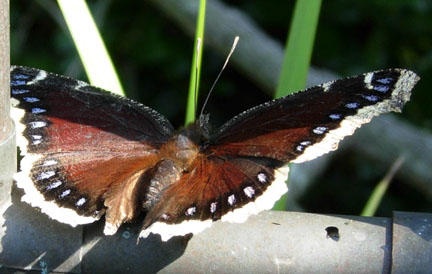
The metamorphosis of a caterpillar into a butterfly (here, a mourning cloak)--the breakdown of tissues into goo that reforms itself into completely different tissues all on the say so of the specific structure of its chemicals--comes as close to being magic as anything I know of...

Sunday, September 26, 2010

WINGÉD THINGS

(Yeah, even more bugs. So?)


What's in a name?


These moths are sublime, whatever they may be called--and I sincerely doubt any name could begin to do justice to that glorious creature on the miniature rose. (My moth book is no help whatsoever; everything pictured in it is dead and spread-eagled with a pin in its back, and many of the plates aren't even in color.)

ED. NOTE: Unlike myself, the Cape May Brit loves to pin names on things. Therefore I now know that the funky brown moth is a Soybean Looper ("looper" for a description of the caterpillar--an agricultural pest--and its locomotory efforts) and the lovely tan moth is called something I can neither spell nor pronounce and that doesn't do it any sort of justice at all.


Last week was also aflutter with butterflies: migrants, vagrants, and the last batch of locals.


Mourning Cloak. My-favorite-color blue, metallic-y cream and burgundy-brown... And how about that striation on the underside? Magnificent. (Little too much sun and shade to show this beauty off as it deserves, but with flutter-by's you take whatever photos you can get.)


Silver-Spotted Skipper. The only skipper (the "little brown jobs" of the butterfly world) other than Long-Tailed that I can confidently ID. And one that actually stays still nearly long enough to see clearly, although that silver spot stands out well even when the skipper is being a typical hyper skipper…


Question Mark. See it? A Comma doesn't have the dot. (I kid you not! Honest, those are truly the common names of these incredible dead-leaf mimics.) The white legs kill me...


Believe it or not, the topside of the Question Mark. Neat, huh? I'm not sure what's up with lavender edges on an orange butterfly, though... (Freaky Fact: this individual, because it is orange throughout and doesn't have mostly-black hindwings, is recently-hatched and will over-winter as an adult. Unusually warm and sunny winter days can bring out the commas and question marks and mourning cloaks. Butterflies in February! Nature is a weird and wonderful thing…)


Not-yet-wingéd thing: a clearwing moth caterpillar, hanging out on its food plant, a native honeysuckle. Caterpillars of Eastern North America tells me this is the less-typical brown coloration. (The green/teal/turquoise-y version must be spectacular in person.)


An adult clearwing from a few years ago. Also called hummingbird moths for their habit of hovering while feeding, thereby being frequently mistaken for hummingbirds.

Wednesday, September 22, 2010

YES, MORE BUGS...

I have only one thing to say about posting yet more creepy crawlies:

Black Swallowtail caterpillars are too damn photogenic.


Landscape! (with bug)