Showing posts with label moths. Show all posts

Thursday, May 22, 2014

Camouflage.


You can blend-in in the country and stand out in the fashion world...

(Gotta love Brad Paisley—to be able to have hit songs about camouflage and ticks, for crying out loud. Awesome.)

When camouflage works [find the butterfly]:


Always look near the center of the photo. To be fair, this Henry’s Elfin is tiny—far less than an inch long.


When camouflage doesn’t work:


Found this very large—book notes average size up to 57mm wingspan and this glorious creature was easily over 60mm—moth on my shed door. (That door is becoming a very good place to find stuff!)


Had the Tulip Tree Beauty been on the trunk of the tulip tree, I doubt I would have seen it at all...

[Have been taking lots of photos lately so of course I'm falling way behind. I may be doing a bit of backtracking, like here where these photos are going on a month old. Sorry.]

Thursday, September 12, 2013

Glad somebody thinks it's fall...

Goodness knows, summer seems to have returned after the teasers of mid-50° nights we had the other week. But just as retail stores are decked out in Halloween and other autumnal decorations, this little caterpillar is showing off its fall colors.

A coworker gets a bit miffed at people making up new names for beasties that already have names that have been used without trouble for a very long time (that's a Brit for you). But I have to admit that I like "Halloween Paint" much better than "Camphorweed Cucullia" for this glorious little creature... (And before you ask, it turns into a dull little brownish grayish moth, whose only distinguishing feature is a furry "hood" over its head. Here we call them "Hooded Owlets" but the British name for the moth group is, admittedly, more fun: Sharks.)


Tuesday, March 5, 2013

"I just saw a baby hummingbird!"

Well, no, I haven't and not right now... But you may have, were you so lucky to have found a nest some hot summer day. And if you were so lucky, I'm seriously jealous. 15 years of living in breeding hummingbird territory and zip. Zilch. No nests found on my property. *phbbt*

Strictly speaking, a bird that is out and about on its own is more of a juvenile than a "baby", and is usually not smaller than an adult by the time it's operating under its own power. Some young birds are actually larger than their parents--which makes sense, considering they are being stuffed full of food they didn't have to work to acquire, and in some species they may even have larger feathers than an adult's in order to compensate for less flight experience...

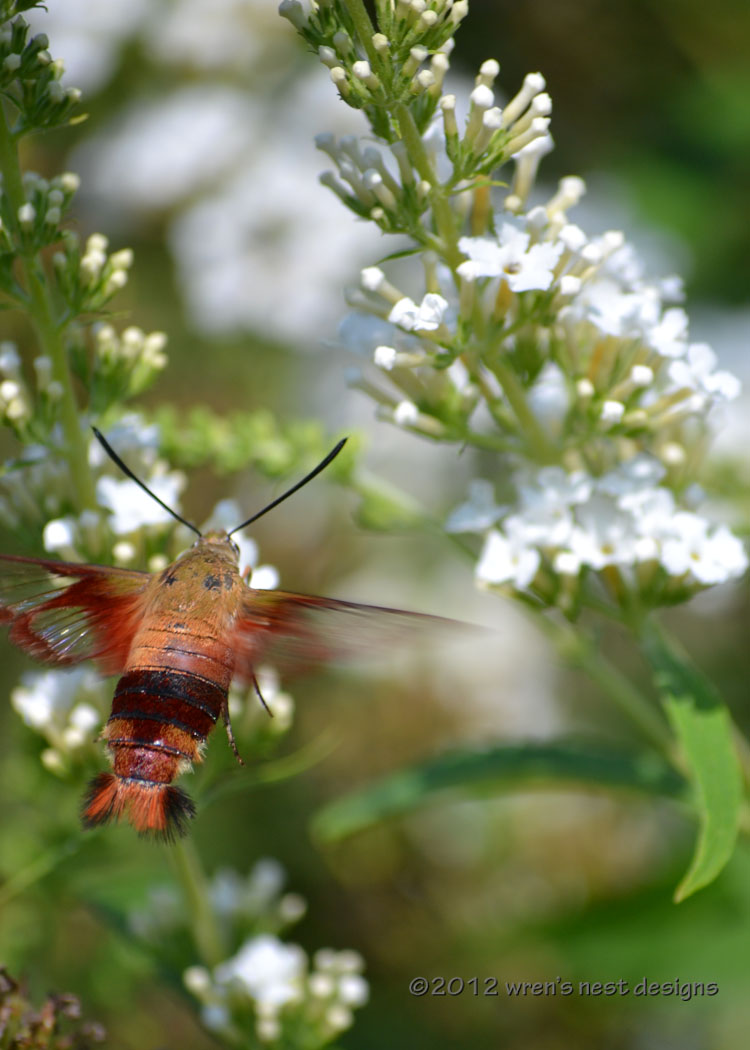
Most people who claim to have "baby hummingbirds" flitting among their flowers are seeing the appropriately-named Hummingbird Moth. They are hummingbird green and can zig and zag with the best of the avian hummers. Not to mention they are smaller than their namesake bird and fly in the daytime as well.

Don't know what it was about the hummingbird moths this past summer, but they were the most amazing rusty-red color as well as hummer green... And there were a lot of them. 


Good thing they were so plentiful; it upped my chances of getting a good photo. Which I did. Ha!


Here the wing blur is a good thing. That sure looks like a figure eight to me, and that motion is what allows a hummingbird to fly backwards. These day-flying moths can as well. Willing to bet that twist is why...

The almost-perfect photo. I could almost convince myself that having the moth almost-but-not-quite-in-frame makes it a more interesting picture. Almost.


Wednesday, June 6, 2012

Belleplain, Early June.


Tarkiln Pond: a very pretty location as well as productive for all sorts of flora and fauna. Located along the northern border of Cape May County in Belleplain State Forest.


Veggin' the edge. Botanizing the blacktop… A large percentage of roadside plants are non-native, but they are numerous and beautiful. (And fearless leader Mike Crewe knows them all. As he should--for him, they are natives!)


Forget flowers; this onion (your everyday oniongrass, the non-native common wild onion) just clones more baby onions that will simply drop off and, hopefully, take root. (Mike has dubbed it the "Rasta Onion"… Walks with Mike are always amusing as well as educational.)


Deptford pink. A non-native but very lovely little flower.


Tony really gets into this birds and bugs and botany stuff…


It might be some species of tiger moth caterpillar. As thorough as my huge (nearly 2 inch thick) caterpillar guide is, it has a photo of a near-identical cat titled "Agreeable Tiger Moth" but with little info beyond that.


I'm not even going to try for an id on this "inchworm" (more like inch-and-a-half worm) but a closer look by Mike at a haphazardly nibbled bush along the roadside turned up the culprit and it cooperated for its portrait.


Where's a Peterson's Eastern Moths Guide when you need one???


Nearly the smallest example of its order (damselflies), a Fragile Forktail. It's little more than an inch long in real life--the inchworm was considerably bigger.


American Lady. She looks large in this photo, but she was actually a very small representative of her species.


American Copper. This is as wee a little butterfly as it appears.


Much to my surprise, I'm very quickly falling in love with waterlilies… (With Photoshop's "Ink Outline" filter this time.)


This web's maker was nowhere to be found. Some orb weavers are more nocturnal than not, so she may have been hiding under the sluice. With my vertigo, I certainly was not going to lean over to look for her, guard rail or no guard rail.


Wow! Blue and violet together on a damselfly; my favorite colors on a favorite critter. ("Variable Dancer"--who comes up with these names?!)


A quite striking female Spangled Skimmer. (Note that dragonflies hold their wings out flat, for the most part. Damselflies hold their wings over their backs, for the most part. There are always exceptions.)


And a more subtle but just as striking female Ebony Jewelwing.


This male Sparkling Jewelwing is even more impressive a creature. A rather appropriate name, too, as these particular damselflies (there were four males flitting about in the sun alongside the Tuckahoe River) were so iridescent that they really did appear to sparkle!


What trip leaders do after a walk while waiting for sandwiches at a local custard-stand-type eatery. It appeared to be some kind of football (not soccer--Mike is a Brit) crossed with volleyball…


(Sparkling Jewelwing male again)

Sunday, October 30, 2011

Hallowe'en the Mother Nature way.

How marvelously appropriate that just before All Hallow's Eve a Black Witch was found in Cape May…


Thanks to Jim McCormac's blog (thank you, Jim!), I knew exactly what was going on when the Cape May Brit suddenly exclaimed "Black Witch at the lighthouse!!!" and raced out the door. I was the only person running out the door right behind him. And I had both cameras with me. ("Never leave home without them." Seriously, it's become a mantra.) Oh, happy, happy day!


Also known as Mariposa de la Muerte * (it just gets better and better…), this tropical moth is common in Central and South America and "regularly present" (according to my Peterson's Eastern Moths) in southern Florida and southern Texas. It happens to be an acknowledged far-north-reaching roamer as well, hence her presence (the creamy pink bands indicate this is a female) in Cape May Point State Park on October 28, 2011. (See the Butterflies and Moths of NA page for a public-reported sightings map--note that this isn't [yet] a complete or comprehensive records data set.)


This is a big moth--about the size of a Cecropia, one of our native giant silkworm moths.


Oh, my… ::sigh:: 


* Alas, all the glorious yet inexplicably and horribly maligned wildlife destined to become harbingers of death! Legend says that if Mariposa de la Muerte (yes, of course I spent the rest of the day practicing my accent on this delicious name) visits when one is sick or lands in all four corners of the house, death results.

Tuesday, October 11, 2011

Why I Take a Camera Almost Everywhere.

Stopped to check my mail (forgetting it was a national holiday) after getting home after sunset last night. Noticed an odd fluttering in the shrubs when I went back to the truck. Something rather large was flying around the honeysuckle. (A few branches put out blooms this time of year.) I totally understand why people sometimes mistake sphinx moths for hummingbirds; I sure as heck did at first.


A closer look--click photo to bigify--at this photo (lightly tweaked to bring the moth into focus--these things are fast, and it didn't like the camera's focus-light) explains why the winged thing was so far away from the flowers: look at that tongue! Hee-hee, its eye even reflects pink…


H@ly ^*%&ing #$%t. Snapped six "frames" and one was THE shot: cropped but not tweaked. (I really must learn some more swear words for situations like this. Bad enough I was standing in my drive hopping up and down squeaking, "I got it! I got it! I got it!". *sigh* If the neighbors didn't already know I'm nuts…)

Ready for its name? (Oh yeah, I looked this one up.) It's a good one: Pink-spotted Hawk Moth. (Only one of its family with pink on the abdomen, according to my Peterson Eastern Moth Guide; its cousins, like the Tomato Hornworm, have yellow spots.)

Monday, October 10, 2011

Chilled Out.


Mornings have been chilly lately, and I'm not the only one affected. Been loving them though, not the least reason being that they slow down the flying things really well.


Found this snowberry clearwing, aka hummingbird moth (many people mistake them for "baby" hummingbirds), under my deck umbrella one chilly morning a few weeks ago. Didn't want it waking up only to batter itself to bits under the canopy (they typically have that hairless spot on their back), so I took advantage of its near-frozen state to get a few photos that would be nearly impossible under other circumstances.


When disturbed, clearwings flicker their tail, um, feathers. Rather like a miffed cat thwapping its tail, I suppose...


Well, it was cold! That was the best it could do.