Sunday, February 13, 2011

LIVING IN GLASS HOUSES.

Speaking in metaphor? Moi? Hah. I'm a very down-to-earth person--I'm talking about these glass houses:


Living in Glass Houses: My Trip to Longwood Gardens

Everywhere I've worked as an interpretive naturalist up and down the East Coast at far-from-obscure sanctuaries and parks, I've heard the refrain "I've lived here x-number of years/half my life/all my life and never knew this place was here/never thought to visit before". I don't find this refrain at all surprising, because I'm guilty of it myself.

I have spent nearly half of my life little more than (sometimes less than) a half an hour away from not only locally-famous but world-renowned locations without ever having visited them more than once or twice or even at all. Not for lack of interest. Not one good reason for not going, really. So when a popular artist-author-naturalist-public speaker mentioned that she had updated her events calendar on her website, curiosity made me check it out. This past fall I attended a local event where her husband gave the keynote address and I wanted the matched set, so to speak.

Much to my delight I discovered that she was going to be giving the keynote address for a public event at one of those places I had been looking for an excuse to visit. One of those places that was located "just up the road" from where I'd lived half my life, yet had only visited twice in all that time. It was do-able as a day trip from my current abode, so I signed up and made plans for a road trip. (And she thought no one would wish to travel a hundred miles to see her… Hah! [Okay, so it was more like 80. Whatever. Close enough.])


A beautiful (if frigid) early morning drive took me to a snow-covered Longwood Gardens. (Check out their Facebook page for stunning winter photos!) Winter does have its good points--would the fantastically tangled and twisted trunk of this tree have been as visible were the tree in full leaf?--but by February I'm more than ready for greenery and at least a hint of warmth.


A brisk walk from welcome center to conservatory led me to the perfect retreat from a cold February day.


Aaaahhh… That's more like it. The current display theme: Orchid Extravaganza.


I have unintentionally, and with great dismay, killed my fair share of orchids* so I wasn't tempted to fill my pockets with new victims. Much. I figured I would be able to enjoy without coveting. The two hour drive home in temperatures hovering around freezing was my guarantee that I'd not be committing first degree murder of (more) innocent plants. This trip, anyway.

I have had to narrow down the shots I gathered throughout the day so as not to overwhelm either my blog or my readers, so let's start with the bigger pictures. Due to the quirks of blog scrolling, the "older" posts are in fact the continuation of this one.


One little corner of the Children's Garden. I had to resist delving deeper into the garden because it features water. Lots of water. Flying water as well as fountains. Fantastic for kids and kids-at-heart who like to make a splash, but not so good for the electronic equipment hung 'round my neck…


For some reason, the large orchid display intended for this location (the Exhibition Hall) had been removed the night before and was not replaced. Even so it is a beautiful space in and of itself, and I was lucky enough to take this photo before the water had completely drained off the sunken floor later in the day. (Reflecting pools are marvels of artistry in and of themselves, and what an incredibly brilliant design feature to have the ability to flood an exhibition area for the purpose whenever it's desired.)


The Palm House. Oh, my...


And that's just the top of trees. (This makes an absolutely awesome desktop photo, by the by; let me know if you want a larger version.)


This building is stories-tall, and yet as you can see it has a below-ground level as well. I was too enthralled by the vegetation to allow my vertigo more than a passing acknowledgement.


I found myself often asking the question "how old?" in regards to the incredibly large specimens found throughout the gardens.


Podacarpus, a type of conifer sometimes called "fern pine", provides visual support columns in many corners of the conservatories. Visual and actual height is a very prominent feature here, and is reflected in the disproportionally large number of vertical photos I snapped...


The Mediterranean Garden.


The aptly-named Silver Garden, for the powdery green sheen often found in succulent species.


Not all succulents are lacking color, however, if you look at them from a different angle. (Oh, alright, perhaps the management snuck in a few unrelated blooms for accent, like adding a bright pillow to an otherwise monochromatic room…)


From one extreme to the other, dry to literally dripping. (Oh my poor optics.) I love the dense, little-bit-of-everything nature of the display in the Tropicals section of the gardens.


In such regal, even grandiose, surroundings it was surprising and delightful to discover that somebody on the staff outside of those responsible for the children's section has a quirky sense of humor.


Of course I had to know how the tillandsias (so-called "air plants") were affixed to the door!


Orchids, naturally, were tucked everywhere throughout the conservatories. Here they are elegantly adding color to the Fern Passage.


Cascade Garden. Please do not show this photo to my poor philodendrons and Monsteras; they would immediately die of shame and disgust (instead of experiencing a painfully protracted descent into probable death due to unfair incarceration in a fluctuating, temperate climate with forced air heat and no humidity to speak of for half the year and a caretaker who fails to provide adequate enough compensations for such conditions) if they ever saw what they were meant to be… *sob* I feel guilty enough as it is.


Just add birds and fish, and I'd be ready to move in to these glass houses...

*It's not that orchids are difficult. Some of them are purported to be rather user-friendly. It's just that they seem to like consistency, and I'm not very good with consistency when it comes to plants. It's really not a positive thing to walk around a conservatory saying "Oh, I've killed one of those! And one of those. Oh and that too, and it takes some doing to kill one of those…"

LONGWOOD GARDENS, Part 2: Orchids

Longwood Gardens has quite an extensive and diverse collection of orchids; these are but a handful of the plants on display, those that happened to catch my eye upon first glance. (I didn't look too closely. Orchid Death By Wren, remember…) You may have no interest whatsoever in orchids, but you cannot deny that these unusual and fascinating flowers are worth a few photos. Enjoy!


LONGWOOD GARDENS, Part 3: Houseplants?

I suppose that after a time (perhaps even a relatively short period of time) of living shut up inside of dwellings separated from the world around them the human race discovered it missed living among, well…other living things. It would be interesting to research how far back the evidence for "houseplants" goes. Long before the easy-care orchid varieties began hitting the general market with serious intent, tropicals cultivated for their foliage alone have long been a favorite choice to bring indoors and are widely available practically everywhere these days. But just as my heart aches to see video of parrots in the wild, a smaller but equivalent pang hit me when I recognized in the Longwood conservatories many plants I have tried with more or less success to keep alive in my own home. To see them in conditions more suitable to their actual needs was eye-opening.


Bears Foot Fern. Yeah, "rabbits foot" just doesn't cover this six (seven? more?) foot tall behemoth… Eek.


My gorgeous little eight-inch birds nest ferns didn't survive the transition from fresh, humid summer air and consistent watering outside to the dry, less-than-pure indoor air and sporadic fall watering. *sniff* This was a typical birds nest specimen for the gardens; note the basic bricks for scale. (*waaahhhhh*)


Occasionally you find dessert-plate size staghorn ferns for sale in the garden section of big department stores. As incredible as they are, I resist the temptation to bring them home, knowing that I haven't a snowball's chance of truly "rescuing" them. There is no possible way on earth I'd be able to get one to stay alive long enough to grow, let alone grow to this size. (Even looking so frost-bitten it was impressive. And it wasn't the only plant in the conservatories looking worse for wear after the rough winter we've had. I can't imagine the effort and what it costs to heat literally acres of glass buildings.)


Your basic and fancy philodendrons at maturity under proper conditions--yes, no matter how long the vines of your philo or pothos, they will forever remain "youngsters" for all of us folk who lack greenhouses…


One of the starts-out-large philodendrons showing its true splendor. If you have one of these giant climbing philo or monstera species, please do not trim those aerial roots it sends out! Stick them back into the plant's pot. (A local nursery even gave their specimen's aerial roots their own water saucer. Very clever that, I thought.)


Getting a bird of paradise to bloom in a typical household setting is one thing.


Getting one to this height is something else entirely… One could be forgiven for thinking the commonly cultivated variety (that I managed to get to multiple leaves and about five feet in height before killing) is a miniature. But I doubt it. These were well above my head; the zoom lens fails to give the true perspective here.


Although not a typical houseplant--it's more geared to the yard--elephant ears is one of the few super-sized plants that can achieve full growth for any attentive gardener.

LONGWOOD GARDENS, Part 4: Tree Ferns

You can actually purchase these ancient-lineaged plants in the big DIY stores. (Mind, they come in more manageable sizes.) I have done so. And I failed at providing it with what it needed to survive. Dinosaurs? *lol* Obviously not; tree ferns (so called because they are cousins to those leafy little ferns you may see on a walk in the woods) and cycads (to be more scientific about it) are everywhere in the Longwood conservatories…


Wood's Cycad, according to its nameplate.


I love this little vignette.


A raggedy specimen, yes, but look closely…


Opportunistic little ferns found their own home. So there! Take that, you horticulturalist, you… We can do very well on our own, thank you very much!


The fern/cycad from the palm house, up close. With spore case? Oh, my.

LONGWOOD GARDENS, Part 5: A Photo Study

Odds and ends.


The purple haze on the trellises in the Mediterranean Garden was due to this wee pea flower. (Individual flowers were about the size of, well, a pea.)


Spathiphyllium. One of the larger varieties of the "peace lily".

I love bamboo. It can be found in a variety of sizes (I hugged a lot of giant bamboo--we're talking easily eight inches across--while in the Caribbean) and colors and habits (clumping vs. trailing); here it is in "black" with moderately-sized canes a couple of inches in diameter.


Agave, I believe.


Variation on a theme: Mescal this time. (Hens-and-chicks gone mad! *lol* Many succulents share this form if not the stature. Hey, when you find a design that works to keep you alive in arid and/or nutrient poor habitats, you stick with it…)


New growth. Spring is coming!

LONGWOOD GARDENS, Part 6: Oh, yeah. Julie.


Yes, that really is a purple Mac laptop on the podium... Hmmm.

I believe I've been sidetracked from my original purpose for heading to Longwood Gardens in the first place. The keynote speaker provided the spark, the symposium the tinder, the location itself was the fuel for the fire. (Um, what was that about my not using metaphors? Sorry.)

I have been lucky enough to have lived 40 some odd years successfully avoiding having to answer the questions "Who are your heros?" and "Who would you aspire to be like?". Those years have, however, given me the time to actually meet a few people who have provided real and sincere answers. I count Julie Zickefoose as one of them. You may hear her praises sung by any and all of those who have had the pleasure of meeting her in person, so I will merely say that hers is truly a delightful and talented personality.


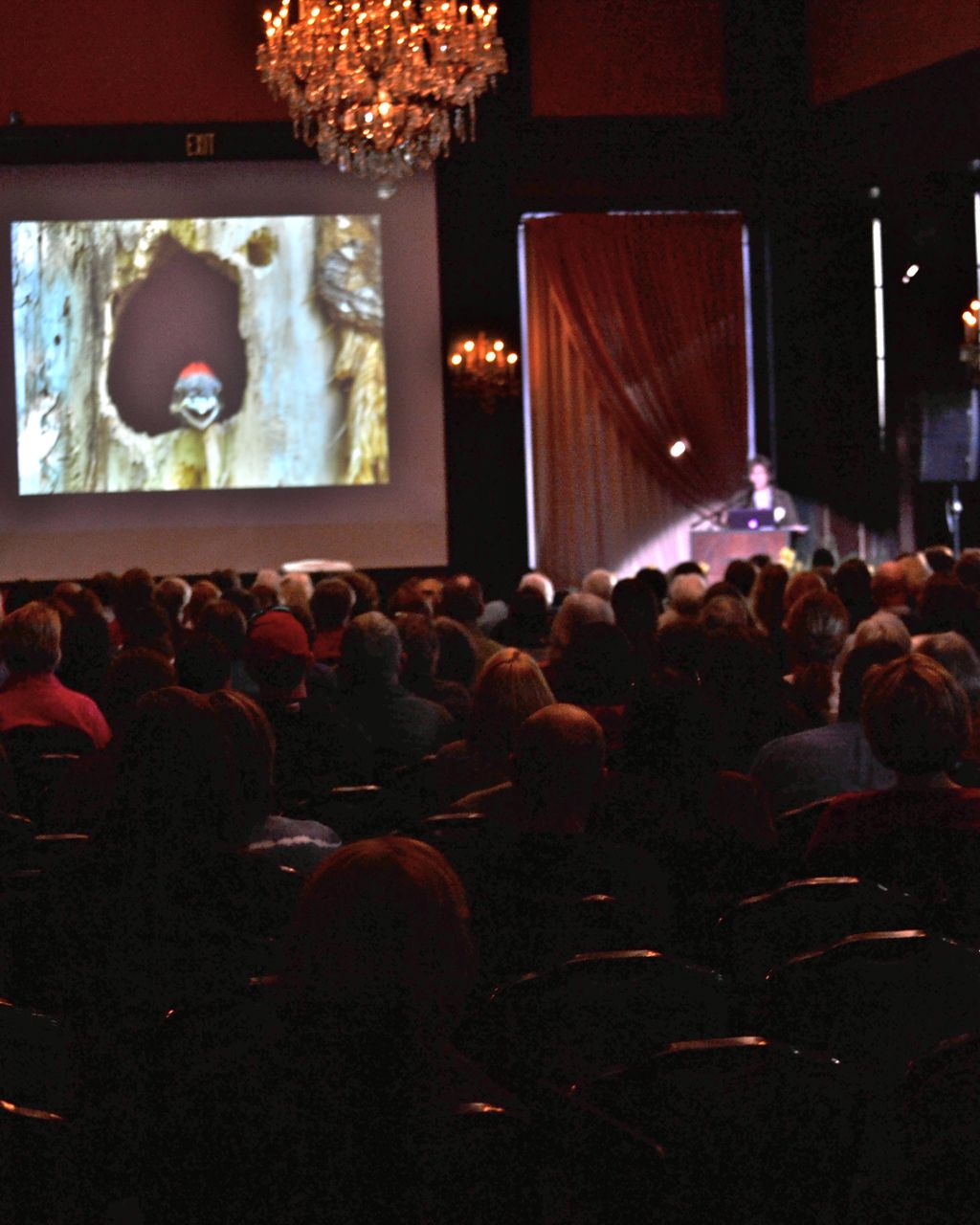
Just a section of a nearly full house. The room was packed all day; I have no idea why there appear to be empty chairs. (Video of baby pileated woodpeckers certainly helped to keep everyone in their seats at the end of a long day.)

Longwood Gardens provided a questionnaire (as all good PR and program departments require) for symposium participants to voluntarily complete. An expected query was, naturally, how we found out about the program. I wonder how many other people listed "Julie Zickefoose"?


Ms. Zickefoose is so generous that when a Longwood Gardens Professional Gardener (event sponsor) asked if she would sign his book, she immediately and cheerfully agreed to do so, pulled out her pen, and used the closest support she could find: her own knees. (Keep in mind that we are outside at five in the evening with a foot of snow on the ground all around in about 32 degree temps… With a breeze. What a gal! Just look at that smile.)

Despite a ballroom full of professionals and talented amateur gardeners, professional growers and designers, Julie's talk highlighting her family's horticultural efforts at Indigo Hill--mostly involving native species-at-hand--was incredibly well-received, and in her turn she seemed quite happy and grateful for the chance to be there. The orchids certainly helped. JZ not only covets orchids, unlike yours truly she can not only keep them alive but actually thriving. A plane trip home secured her good behavior. Unless she snuck back into the shop after we said farewell… >:o|


(Ms. Z was quite tickled that that "Speaker" ribbon earned her a behind-the-glass trip into the bonsai room. Check out photos of her own bonsai on her blog; a search by keyword should turn up a post or two.)

All in all, a trip that was not to be missed. And one that really should be repeated sometime before twenty more years pass.

Sunday, February 6, 2011

ARMFUL OF TIGERS

The MacBook camera isn't quite up to the standards of the Nikon DSLR, but it'll do well enough for you to get the picture of what working on a computer is like in our house…


As amazing as red toms and black & whites are, I'm beginning to believe that my Tiger Lilies may have them beat for outstanding personality. (The trick is to keep the two girls from beating each other to flinders.) Persephone* is being held to keep her off the keyboard and off of Cassandra in my lap.

*They are Cats; I try to avoid simple names when at all possible**. We use Sephy (or Sephone) and Cassie until someone gets into trouble… At least they don't have middle names.

**I will admit that we do have a Peanut. She was a former yard cat who was caught sitting on a nest box full of baby wrens one day; "You little peanut!!!" yelled out the window worked to get her down. What a surprise when she answered to Peanut as soon as she was brought inside. She even comes when called.

YOU MUST BE JOKING.


The afternoon high in Cape May County on the day about a third of the country had accumulating snow or an early morning ice storm...

Thursday, February 3, 2011

THANK YOU.

A shout-out to all of my wonderful, creative and crazy blog-osphere friends who have a link to Chatter on their own blogs...!

Please do stop by, they are well worth a visit. Links are to the right.

Tuesday, February 1, 2011

LEARNING A LESSON: Exposure

Thanks to an all-too-rare-this-time-of-year clear sky, there was a rather incredible waning-crescent moon rise on Monday. (And although Venus has a good lead on the moon these days, it can yet be captured in the same frame.) Still don't have the tripod within reach for these spur of the moment and fleeting photo opportunities, nor do I yet have a handle on aperture settings or how to get a basic little lens to focus on a relatively small, very distant point behind many detailed objects, but I did have a chance to play with exposure.


This is what the camera saw when allowed to set its own exposure time. Wow. What I was actually seeing with my relatively good night vision wasn't anywhere near close to this… (Trust me, there's a sliver of a moon hiding alongside that very straight-trunked tree on the left.) Because sunrise was in fact a bare hint on the horizon, the camera left the diaphragm open a good long while and the circuit board soaked up as much light info as fast as the wee little processors could handle. (It is also amazing how in-focus this shot is given the long exposure and my very shaky grasp on the camera.)


Whoops, not enough time to let the pixels percolate. (That's the moon, not dust on your monitor!)


Ah-ha, that's closer to what I was actually seeing. (Ok, as dark as this is, I had to cheat and lighten the exposure. Reducing the photo and posting it darkened it up considerably from what it looked like straight out of the camera.)


Still to be learned: (1) Figure how to shoot on a tripod out this window, and make sure the tripod is in the house when it's needed to shoot out this window. (2) Work on learning about aperture settings, because the tripod doesn't bear the sole responsibility for clear focus.