Tuesday, March 5, 2013

"I just saw a baby hummingbird!"

Well, no, I haven't and not right now... But you may have, were you so lucky to have found a nest some hot summer day. And if you were so lucky, I'm seriously jealous. 15 years of living in breeding hummingbird territory and zip. Zilch. No nests found on my property. *phbbt*

Strictly speaking, a bird that is out and about on its own is more of a juvenile than a "baby", and is usually not smaller than an adult by the time it's operating under its own power. Some young birds are actually larger than their parents--which makes sense, considering they are being stuffed full of food they didn't have to work to acquire, and in some species they may even have larger feathers than an adult's in order to compensate for less flight experience...

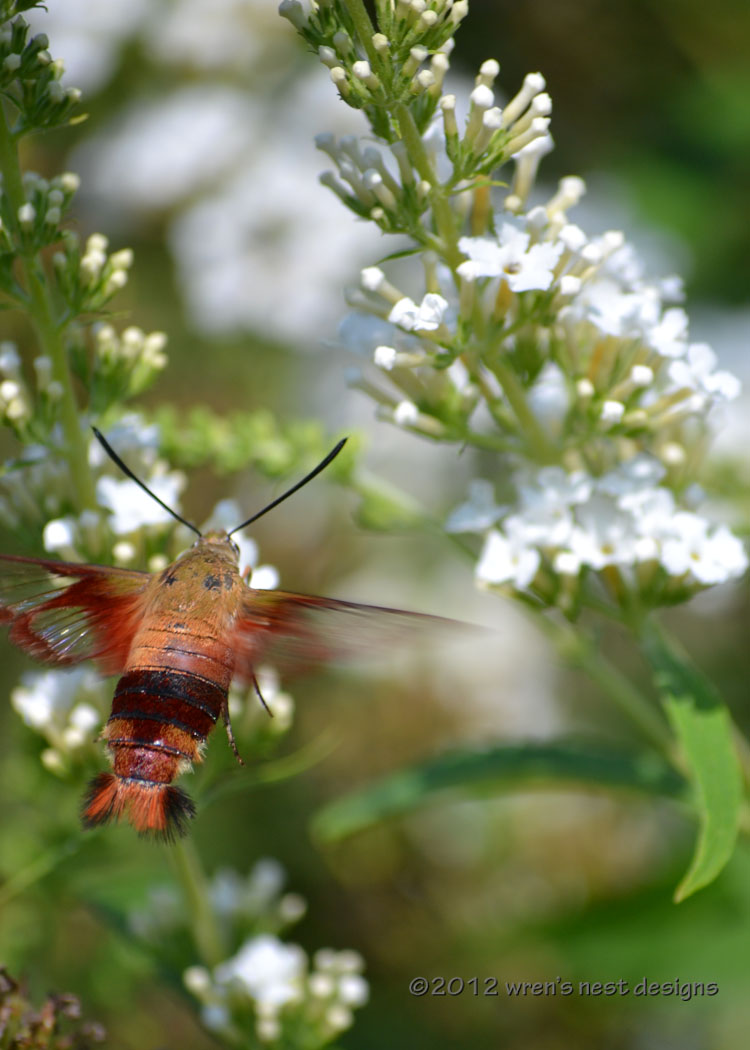
Most people who claim to have "baby hummingbirds" flitting among their flowers are seeing the appropriately-named Hummingbird Moth. They are hummingbird green and can zig and zag with the best of the avian hummers. Not to mention they are smaller than their namesake bird and fly in the daytime as well.

Don't know what it was about the hummingbird moths this past summer, but they were the most amazing rusty-red color as well as hummer green... And there were a lot of them. 


Good thing they were so plentiful; it upped my chances of getting a good photo. Which I did. Ha!


Here the wing blur is a good thing. That sure looks like a figure eight to me, and that motion is what allows a hummingbird to fly backwards. These day-flying moths can as well. Willing to bet that twist is why...

The almost-perfect photo. I could almost convince myself that having the moth almost-but-not-quite-in-frame makes it a more interesting picture. Almost.


Sunday, March 3, 2013

It really IS purple...


On my way down my drive one morning last summer I managed to spot a Red Spotted Purple catching the light just the right way to actually show the "purple" of its name instead of the usual peacock blue. The camera didn't quite catch the full effect, but you can definitely see purple… (If you look really closely, you can even see the red spots, too.)


Thursday, February 28, 2013

Find the Frog.


This is the first time I've ever seen one of our gray tree frogs with any hint of green on it. Evidently they can go totally green, enough so that they near-identically resemble the common green tree frog found in the southern US. I suppose there had to be some reason its species name is "versicolor".


An acquaintance brought this one back to Cape May County after it had apparently hitched a ride to the city when he went home after a visit this past summer. Must have been just enough green in the substrate of its holding container to start the change. Luckily, I found a lichen-covered tree that perfectly matched the frog!


Looked pretty good on red (Dave's shirt), too.

Saturday, February 16, 2013

Insect Collection II

A typical cold, wet, dreary Mid-Atlantic winter day needs a bit of lightening and warming up, so here are some photos from this summer I've (inadvertently) saved for a needy day... And the premise of my Insect Collection series: Use a camera instead of a jar with a nail-polish-remover-soaked cotton ball in it.


A skipper dusted with...pollen?


An ocola skipper, a rarity that showed up in Cape May in numbers in 2012.


Least Skipper. Hard to tell from this how tiny it really is.
(Photo is at least twice life size.)


Gray Hairstreak, topside. (Ailanthus moth behind it.)


Fiery Skipper on aster. Definitely one of my top-ten favorite shots of 2012.

Friday, February 8, 2013

And a Bit of Green Before You Go.

Or, in the case of the major Nor'easter barreling into the East Coast today, "A Bit of Green Before It Snows"...


Despite some areas of the conservatories looking a bit frost-bitten, the past year did wonders for the Green Wall at Longwood Gardens…


Green Wall, February 2012. Really neat design, actually; it's planted in flats, so they can remove a small section and replace it with another if necessary. (You can see the row divisions between the young plants here...)


Is it still considered plein air when there are a roof and walls (albeit made of glass)…? (Wish I had taken the time to pull the camera back out; the near-finished painting was rather lovely, much better than the early stages promised.)


Wednesday, February 6, 2013

Pretty as a Picture.

More from my February 2013 trip to Longwood Gardens...


I admit to having a soft spot for succulents. I simply like they way they look; and the impressions of the leaves on leaves of these agaves really caught my eye this time around.


Another "succulent": fan aloe, for obvious reasons.


A terrestrial plant that freakin' looks like coral. It's actually a bromeliad, a family that more typically includes "air plants"--epiphytes: non-parasitic plants that live on other plants in tropical regions. And this one is in the desert room, so one assumes it doesn't rely on the higher humidity that other members of the family need… Plants are freakin' amazing.


Most of us temperate-zoners use elephant ears, caladiums, alocasias and their relatives--all of the over-sized, arrowhead-leafed lovelies--as foliage plants... Not sure of the family/genus here, but in the Palm House, it's happy enough to flower.


Not your grandmother's geranium! But it is a pelargonium. Oh, the horrible twisted things we humans have done to plant genetics… (I must admit, I do like the leaf shape, though. *sigh*)


Not sure which orchid this is or how "natural" is this form, but it looks nothing like a "typical" orchid (unless you take it down to its component parts, the Orchid Room volunteer told me). The fact that about a third of this variety's flower sprays were perfect double helixes really tickled my fancy.


I could oh-so-easily become addicted to bamboo. There are even clumping varieties that do not escape their containers, even if the collecting of bamboo plants were to get out of control…


As groomed and trained and bred as conservatory plants are, sometimes they get a little of their own back--like this pink-blossomed individual amongst a sea of white. "HAH. So there!" Vegetative version of a certain crude hand gesture, would you say…?


One of these days I will make an attempt at keeping carnivorous plants. This is the flower of a pitcher plant! Who knew?


Quickly becoming my all-time favorite flower, I must find out if I can grow Coral Pea at home…

Sunday, February 3, 2013

Finding Color in Winter...


For me, finding splashes of real color as winter settles in to stay for a while (maybe) involves a road trip. Visiting Longwood Gardens on the first Friday of February is becoming something of a habit for me.


Or a ritual...


I'm sure the Today's Horticultural Symposium is specifically scheduled for that particular date. We've usually had enough winter by then that people are getting a bit antsy and cabin-feverish--especially gardeners, I'd imagine! Despite February's odd weather (crazy cold to snowy to 70 degree days and everything in between), red-winged blackbirds warming up the pipes ("No, not yet, you idiots!"), maple trees half way to blooming ("No, stop that, you stupid tree!" Hmm, on the other hand, that's less seedlings to eliminate from everywhere they aren't wanted...), I too find February a bit rough to navigate.


On my first trip to the symposium in 2011, there was a foot of snow outside of the conservatories (our South Jersey accumulations had already melted). 2012 proved to be a mild winter, but no matter how warm it is, winter is not green and certainly not anything near lush. I thought 2013 would hit somewhere in between, but I actually drove into a snowstorm. Or rather, out of, as it was a "clipper" and hit hard and fast across the lower Delmarva and Cape May peninsulas… The Gardens were clear but I came home to ankle-deep drifts of cold white stuff on my front porch. *hmph*


This year's symposium had a number of topics that interested me, so I splurged and decided to make the trip again this year even though I didn't know anyone attending. (The previous two had the primary attraction of being able to meet online friends in person.) I have a new camera lens this year, so I figured some photography would be in the offing, even as I wondered what shots I could pick up this time around that I hadn't managed to get before. (The conservatory displays don't change all that much.)


Note to Self: Learn How to Operate Camera. The new macro (close-up) lens is delicious, but I really, really need to learn how to manipulate aperture and "film" speed and such in order to use it well enough to justify the purchase… And remember to make sure the vibration control is on. And to grab the monopod even if I am late due to a forty-minute traffic jam I only allowed twenty minutes for…


I only passed up one talk, but combined with a long lunch break (the food is no small part of the attraction of this event!) it was enough to take a quick spin through the conservatories. The snowy season of 2010-11 had done some damage even in the heated houses, especially around the outer edges where plants were too close to the glass. Last year's warm winter had the plants responding well. But apparently the one truly cold snap we have had so far this year hit the plants hard. Else more was going on that was not evident, for there was quite a bit of subtle damage throughout the conservatories. And they felt a few degrees cooler than "usual". (I really need to find someone who can answer "What does it take to heat this place?!")


But this is Longwood Gardens we're talking about, so there is always enough greenery and blooms to make up for whatever is happening on the other side of the glass walls.


Notes on Photos:

If I were to start obsessing on particular families of plants, one could easily be hibiscus. Hibiscii? Funny though, I don't like the "fancy" varieties, even though most of the plants I own have, in some cases, highly multiple-petal blooms. (Apparently that's the marketable version these days.) Love these flat, simple forms. What a palette for playing with color…

Neoregelia sp., a bromeliad that grabs the eye, even--or perhaps especially--when displayed at shin level.

Yellow is far from a favorite color of mine, yet I kept finding myself drawn to the yellow orchids. Granted, they seemed to be the primary color for the display this year, but still…

Close up of a sundew. The little (couple of inches) leaf refused to come into focus, so this is a lower resolution photo with more tweaking.

Might be an aloe in bloom. Leaves looked like an aloe. Couldn't find its name tag...

A sure winner when it comes to color: bird of paradise.

The colors of this bromeliad's bracts (Aechmea sp.) never get dull.

(Sure wish I could figure out why Blogger double-spaces some paragraphs and not others when the font looks to me like it is formatted the same way throughout... *sigh*)

Wednesday, January 30, 2013

White Out.

And January 30th or not, I don't mean snow. The mainland was clear and I thought the barrier island was losing its light, gauzy wrap of morning fog...


Apparently not, as evidenced a couple of hours later. You can't even see the osprey platform near the edge of the marsh across the water. (As I have to navigate myself back off the island, I suppose I should be grateful I can still see marsh [what there is of it to see]. At least I'm not going by boat.)

Stupid weather.

(Photo is much better when you click on it. You can see the shadow that is the osprey platform if you know where to look.)

Friday, January 25, 2013

Was this really necessary?

Just because I was commenting--not precisely complaining--about the so-far mild winter (when I was expecting a rougher one than last year) just the other week, was it really necessary that Mother Nature go to this extreme:


Outdoor max/min temps from Wednesday afternoon, January 23rd.

And to not even give us anything like a decent snow with it--! [She fusses, ducking her head as she watches the approach of another winter storm on the radar. ::desperately hoping neighbor with bulldozer is at home::]

Sunday, January 20, 2013

New Pages at Chatter!

Well, actually they are old pages from back in the days when I wrote my own webpage from scratch. (Must admit, that was a whole lot of fun--a bit of mental exercise with a nice payoff.)

WREN PAGES, over there on the left side of the right column of this blog, are permanent pages of stuff I hope you find of interest.

I've just put up Cape May Birding, a little reference guide to get you started if you are curious enough to make a bird-watching trip to Cape May to see what all of the fuss is about. (Alas, no photos.)


The second is a photo essay about one of the ongoing Delaware Bay Shorebirds research projects. It's bare-bones now, but I hope to get in the field again this year to obtain the most recent news. Ought to be a good year to do so, as the only real damage Cape May County suffered from Superstorm Sandy was to the Delaware Bayshore beaches--they took a severe pounding as the hurricane passed us by. Availability of suitable nesting habitat (i.e., beaches) is a limiting factor in horseshoe crab reproduction and a problem due to the "lack-thereof" because of development; with estimates of a 50% loss of NJ bayshore beaches due to the storm, this spring will be a very interesting one for the crabs and the birds and the scientists who study them...

I'll be updating both pages as necessary.

Thank you for looking!