Friday, August 2, 2013

Talk About Timing...

I bought a battery-powered LED lantern the other day. And had batteries of the right size that were charged, so I put them in it. Ooh, nice; that was worth the money. I had, however, neglected to do any grocery shopping, and the fridge and freezer were echo-ingly empty.

Who knew that I'd have cause to use the lamp twelve hours later and cheer an empty breadbox?!

This is the road at the end of my driveway, 2:45am. That's the witching hour out here, 2 to 3 am...


I had rolled over in bed a bit after 2am, awake enough to know I was awake--or maybe the box fan shutting off woke me. In the years I've lived here, the power company has done an increasingly brilliant job at keeping the electricity flowing. There's pretty much only one reason the power goes out around here these days, and that's when a utility pole comes down.


Yeah, that'll do it...

Freaking unbelievably, all three people walked away from this with hardly a scratch. I'm willing to bet they had on their seat belts.


The nice fat cable wrapped around what's left of the front end of the car (a Lincoln, I was told) might quite possibly be the cable that belongs to the cell tower located on the property adjacent to the sheared off pole. Or it was one of the local phone company's brand new fiber optic replacement cables... (Guess we're lucky anybody was able to call for help. Although one emergency person and a neighbor did each have a carrier that apparently doesn't have a relay on the tower.)

I've been living fifteen years now on the worst stretch of highway in the county. Too many curves on an undivided "rural" two lane for the (scarily large) size of the "traffic and driving rules? what rules?" contingent. The former property owner's mother, who lived in the house on the edge of the road (whereas I live way in the back) was killed merely trying to pull out of her driveway. I knew that going into it the purchase, but I felt the land and house were worth it. I still do, despite the one fatality on this bit of blacktop that I know of in that time (not counting last year's deer).

I only went out to look at this one because I didn't hear sirens within a few minutes. There's a handful of us that live out here and the fire house is a half mile down the road, so usually we get sirens soon after a skidding and/or crashing noise and lights popping off.

Our 45 mph speed limit doesn't command the respect it should (some more enforcement would be nice), but adding a double yellow line through the entire residential/multiple blind curves stretch has helped despite the cereal-box (or Cracker Jack box, if you're old enough to remember those! not that you get free cheap plastic toys in either these days) -licensed driver here or there who ignores it (some more enforcement would be nice). What mostly does it in for the utility poles (and the occasional driver whose time on this earth is up) are people falling asleep at the wheel, as reportedly happened in this case.


(*pphff* We only rated one firetruck…?!)

Many thanks to all the emergency personnel: police, fire and rescue, and kudos to one of the line owners who had a truck on scene within the hour.

The view the next morning:


Uh-oh. Luckily, I was going left.


Admiring the carnage. (Click to big-ify; you'll notice that pole isn't actually touching the ground...) I asked the cell-tower serviceman who was sitting in his van at the end of my drive as I left if any/all of these companies had a wall back at the office that had photos of the most impressive pole smash-ups. He replied, "Sadly, we do."


This photo begs the question: How many electricians does it take to change a lightbulb? It's hard to see, but I counted eleven (11) trucks, not including the traffic and my own pick-up on the far right. But take note: My streetlight is ON. Nearly twelve hours to get the power back, and the road was closed for quite a good bit of that time. Accidents along this stretch take out a three mile section that necessitates at least a five mile detour for folks. I have mentioned this state road is one of only three north-south highways in the county...?

I think I might be okay to stock up on frozen dinners now. But with all my luck I bet the sale is over.

NOTE: It wasn't actually as bright at 3am as these photos appear (it being well before even a summer day's dawn and the power being off) and I wasn't using a flash, just a long exposure time with the DSLR set on no-flash automatic. And a tripod. (I may not have been completely coherent myself at 2am, but I did finally convince myself that yes, I really needed the tripod if I was serious about taking photos.)

Sunday, July 21, 2013

Snake in the (sort of) Grass.

Technically, it was in the irises... I was sitting on my deck last week, braving the bugs and heat, when the iris leaves next to the front walk started waving in the dead-calm air. So I watched intently to see what would meander out of the garden and was rewarded with great views of this little neighbor of mine. This is only my second sighting of Rough Green Snake in the fifteen years I've had the property. And it was in nearly the same location; the first one I found was coming up the steps I was sitting on to take some of these photos.


Find the snake! (Click photo to bigify.)
Hint: it isn't in focus.


This species is relatively small, only a couple of feet long
and maybe as fat around as a "safety" crayon at the widest point...


Snake in goldenrod.


Vivid demonstration of why some butterfly caterpillars
(especially swallowtails) mimic snake eyes...

Thursday, July 18, 2013

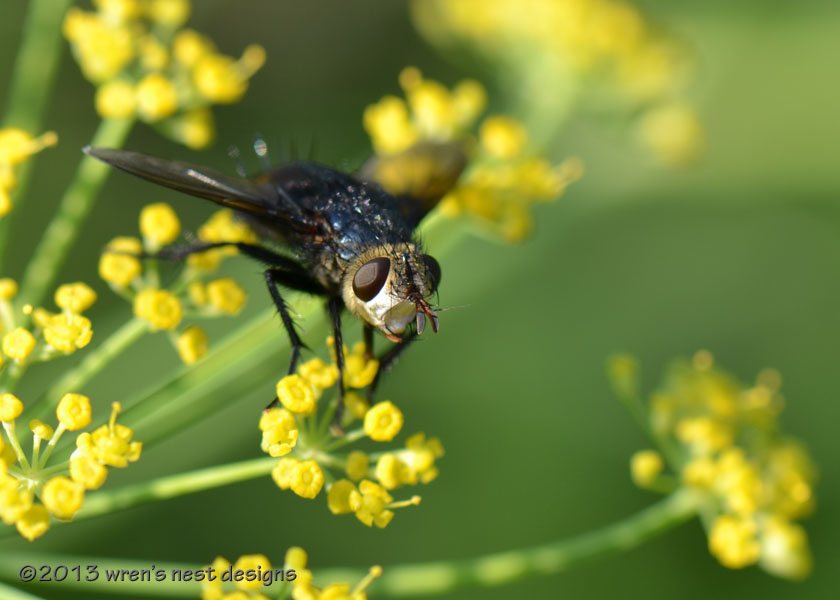
Funky Fly.

Couldn't resist shooting this thing. It's a good size beastie, maybe a bit more than a half an inch. The bristle-ly back was a bit disturbing, but look at that face!!! Might be another Tachinid fly. (Sooo many insects sometimes makes ID problematic. And sometimes it's only entomologists who care to name them all...)


(I'm sure I saw that funny little schnoz moving in and out. Weird...)


Monday, July 8, 2013

Shoo, fly...

No, wait--you don't buzz annoyingly or bite. You can stay.


Crane Fly. (Sorry, I gave up trying to get it to species.)
What's with the funny little balls-on-sticks things on its abdomen?*


Long-legged fly. These are even better looking in profile. Fly on stilts!


I managed to ID this gorgeous itty bitty to the Tachinidae family and then gave up.
(And what's with the funny little plates sticking out of its abdomen...?*)

* Vestigal wings. Most flying insects have four arranged in two pairs; flies have just two (one pair). That's why they are in the family Diptera - "two wings". See, three years of Latin in high school actually did pay off! 

Friday, July 5, 2013

Not to be seen for another 17 years!

Or 13, or whatever year and whatever "brood" it might be...

Periodic Cicadas from Belleplain State Forest. I was about a week "late" for the full effect, but as it was it was pretty impressive. A good strong humming background noise, groups of insects on tree branches, and enough flying around to have a few land on me.


(Why you should have a quick release plate on your tripod.)


Well, hello there...


(Smaller than the yearly cicadas, and completely different coloration.)
 

Saturday, June 22, 2013

Happy Halloween Pennant Summer Solstice!

No, I don't have my holidays mixed up. This Halloween Pennant was out hunting on the first day of Summer. I highly, highly recommend many visits to Cox Hall Creek Wildlife Management Area if you are/find yourself in Cape May County. A former golf course allowed to go to seed, with some active management thrown in; meadows, woods, freshwater ponds and everything that goes with them. Fabulous. Easy-walking paved trails, too. You can even take your bike. (Which I would, if I could wrestle it out of the depths of my shed and if the tires were still capable of holding air...)


Saturday, June 15, 2013

Bluet. But not blue...

Told you there was such a thing as an Orange Bluet... (Bluet is the lump sum of a group of related damselflies. Sort of like the term "sparrow" covers all of those little streaky brown jobs.) For size perspective, note that these boys are perched on the tips of a juniper (cedar) tree.


Sunday, June 9, 2013

Ecology: How It All Works Together.

For today's ecology lesson, we'll look at a tree, some bugs and a bird...


First, we start with the tree; a Tulip Tree in this case. (Once known as "tulip poplar" but we try not to use that name anymore as it isn't, in fact, a poplar. It's actually related to magnolias.)


Second: Tulip Tree Scale. Just like the scale that attacks your houseplants, only this not-as-little sap-sucking insect (the pinkish-orangish blobs) favors tulip trees.


A couple of summers ago, my tulip tree suffered a rather heavy infestation of tulip tree scale. "Not good for the tree," we humans would believe, but the scale insects were having a party. And what the scale excreted provided food for all sorts of nectar-eating insects such as this male Velvet Ant. (Which isn't really an ant, it's a wasp. It's the wingless female who scurries around on the ground that earned the species that particular common name.)

  
The tree survived very well, thank you, but it did lose the limbs that were most heavily affected by the scale. Despite winter wind and hurricanes, many of the dead branches remained on the tree. They started to rot where they were, and the outer bark started to peel away this year. Then the fun began again...

Tulip Trees are wonderfully useful to humans. Their typical tall, straight trunks were once much used for ship masts. (For trees growing close together there's competition for light, so they grow straight and tall and you don't see much branching off the main lower trunk--the leaves would be too shaded. Trees growing in the open, however, develop a different shape--more broad and branching and therefore less useful as timber.)


The inner bark of a Tulip Tree branch that is in the early stages of decay peels/can be peeled into long strips which can then be twisted into relatively strong rope. I can't say as to whether this ever achieved any commercial value, but it's fun to hand twist a bit of bark into rope for a necklace or lacing.

Animals, naturally, figured out the benefits of Tulip Tree bark a long, long time ago... First the squirrels started stripping the dead branches of my tree for stuffing to use in their late-winter nests. As the spring songbird nesting season came into full swing, the Carolina Wrens started grabbing their share.


This weekend, a pair of Cedar Waxwings were in the Tulip Tree, wrestling (with more or less success) their own fibers off the branches to be woven into their nest.


Moral of the story? Don't panic if a tree suffers an infestation; Mother Nature knows what she's doing. A healthy tree will survive, and much benefit can come out of what seems like a great harm.

Friday, June 7, 2013

Purple and native.

Venus' Looking-glass. I have absolutely no idea how or why someone would use that name for a flower (Wikipedia has failed me), but I like it.

In spite of the expected all-day rain left over from the first named tropical storm of the season, I brought the camera with me to work. I have learned better: Always take the camera, no matter the weather. As a photographer friend told me years ago, you can't beat the lighting on a gray, drizzly day...


Saturday, June 1, 2013

Not a bluet...

But similar. This little guy was hanging out with the bluets of the last post and finally stood still long enough to have his photo taken... Rambur's Forktail.


And a female Rambur's, from last August: